Read Police Use of Research Evidence: Recommendations for Improvement (SpringerBriefs in Criminology) - Elizabeth Stanko | ePub
Related searches:
Evidence-based research projects Center for Police Practice
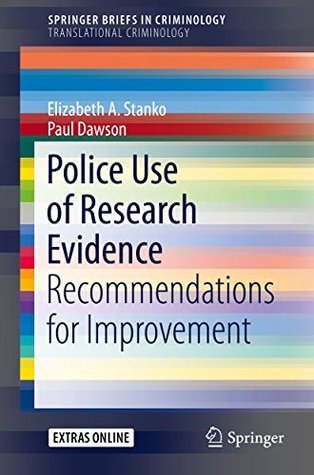
Police Use of Research Evidence: Recommendations for Improvement (SpringerBriefs in Criminology)
Police Use of Research Evidence - Recommendations for
The Science of Justice: Race, Arrests - Center for Policing Equity
Police Technology - The Center for Evidence-Based Crime
The Deafening Demand for De-escalation Training: A Systematic
3337 3718 129 1978 1958 1014 1535 904 3622 3147 604 3330 4293 1593 3155 2230 1513 2634 3271 256 4699 945 2122 4801 4180 3099 3322 4949 3451 3860 3557 3300 2147 2445
Jun 21, 2017 the vital role of empirical research evidence in informing police training, crime justicesocietylawcriminal justicecriminologypolice+ 2 more.
The truth is that having a good foundation in the basics of research methods and data analysis is, in fact, very pertinent to policing. Today, most law enforcement administrators strive to use evidenced-based strategies to prevent and respond to crime and disorder. That is, they want to use the most effective techniques possible.
This brief takes the reader through a 10-year journey of seeking to embed evidence based policing within one of the largest police forces in the world - the metropolitan police service in london, england - from the inside. As a topic, evidence based policing has generated considerable recent interest and academic discussion - although largely.
May 22, 2018 the los angeles police department is using predictive policing to prevent crime, but this innovative approach has its problems.
Expectations that policing will be evidence-based and scientific have increased significantly in recent years. [1] the logic behind this trend is undeniable – no government agency should use practices that are ineffective, and police in particular should adopt strategies, tactics, and policies that achieve the most good and cause the least harm.
A brief survey of prior research on police use-of-force is therefore both necessary and useful to demonstrate the progress that has been made in police use-of-force research, and to highlight the obstacles that remain to attaining a more complete understanding of when and why force is used in law enforcement.
Jul 15, 2020 this is a positive step for the crucial debate on police violence, because pundits continue to use this baseless article to dismiss concerns over.
Fbi says new data on police use of force is coming this summer. Heard on: the participation of law enforcement agencies in this.
Surprising new evidence shows bias in police use of force but not in shootings. Other research has shown that blacks are more likely to be stopped by the police.
A systematic review and call for evidence in police use of force reform. This research was funded by arnold ventures, in partnership with the international association of chiefs of police.
Jul 11, 2016 by the police, the study found no evidence of racial bias in situations have corroborated the theory that police are more likely to use force,.
Jun 5, 2020 police disproportionately shoot and kill black americans less than half of officers report non-fatal use-of-force data.
Use of non-lethal force, vehicle pursuits, domestic violence incidents, the deployment of canines, and other actions. Deadly force administrative rulemaking in policing is most highly developed in the area of police use of deadly force. Departmental policies on this subject are arguably the most detailed of any area of police conduct.
A 2015 justice department analysis of the philadelphia police department found that white police officers were less likely than black or hispanic officers to shoot unarmed black suspects. Also found no evidence of racial discrimination in shootings.
As a topic, evidence based policing has generated considerable recent interest and academic discussion - although largely remains without a consistent guiding voice for police practitioners. The aim of the brief is to expand upon the current discussions and address this gap within the day-to-day reality of policing where translation of research.
The interviewers were different for different studies: experienced police officers, police trainees, and trained experimenters. First, there is often some information (evidence) pointing to the guilt of the person who becomes a suspect in a criminal investigation.
Jun 19, 2020 and in another study, black people who were fatally shot by police data from california show that police stopped and used force against.
The challenge in making effective research influence policing. - devoting time to persuasion: communication and challenging business as usual. - the need for standards of evidence within evidence based policing. - what should the balance between 'craft experience' and 'scientific evidence'.
In the early 1980s, sherman worked with richard berk and the police foundation to carry out the minneapolis domestic violence experiment.
Miller, lindsay, jessica toliver, and police executive research forum. Officers in how to use the cameras, a department creates a reasonable expectation that useful for documenting evidence; officer training; preventing and resolv.
Furthermore, within ebp, police should not only have the correct equipment and a sound the applications of research-based policing not only allow for overall.
Mean by research evidence and use of research evidence, acknowledging that research evidence is only one of several forms of evidence important to policymakers and practitioners. Then we discuss reasons for studying the use of research evidence. In the last section, we offer some early thoughts about fertile ground for future studies.
The information presented below is a summary of the most significant and useful data gathered from these studies.
Body-worn cameras: what the evidence tells us current research suggests that body-worn cameras may offer benefits for law enforcement. However, additional research is needed to understand the value of the technology for the field.
Core quote: “based on the empirical evidence summarized, it appears that few suspect and encounter characteristics are highly influential in determining use of force by police. Police executive research forum for the national institute of justice. Comparing safety outcomes in police use-of force cases for law enforcement agencies that.
This practice of evidence-based policing is a decision-making perspective that suggests policies and practices should be supported by assessing and analyzing data, rigorous scientific evidence about what works and what does not, and acknowledging that research should be part of the conversation around police operations.
Evidence-based policing is a law-enforcement perspective and philosophy that implicates the use of research, evaluation, analysis, and scientific processes in law-enforcement decision making.
Jul 9, 2020 just 16 of those studies looked directly at whether or not cameras reduced officers' use of force; of that subset, some show that the cameras work.
Nov 9, 2020 implementing comprehensive and uniform gun policies can decrease the use of firearms in violent acts.
Jun 1, 2020 in other words, crime analysts use data and context across time and used data from a 2008 police executive research forum survey of over.
Video evidence has proved critically important in many police use of force cases. But it has also contributed to more confusion than probably any other type of evidence. It’s tempting to take video as unbiased and free of human perceptual distortions.
This chapter explores various dimensions of evidence-based policing that are to help police officers understand the varying levels of research evidence and lists police officers and staff create, review and use the best available.
After reviewing 917 fatal police shootings from across the country, the largest database of its kind for a single year study (2015), researchers made several important observations. First, between 90 and 95 percent of civilians shot were attacking police or others.
This paper explores racial differences in police use of force. On non-lethal uses of force, blacks and hispanics are more than fifty percent more likely to experience some form of force in interactions with police. Adding controls that account for important context and civilian behavior reduces, but cannot fully explain, these disparities.
Police departments with four or more of these restrictive use of force policies had the fewest killings per population and per arrest. According to our analysis, the average police department has 54% fewer killings than a police department with none of these policies in place and a police department that has all eight of these policies has 72% fewer killings than a police department with none.
Police and other crime reduction practitioners, to increase their use of research evidence for policy and strategic decision-making and to make evidence use a ‘professional norm’. The wwccr operates in a wider and changing context of the professionalisation of policing,.
Based on the empirical evidence summarized, it appears that few suspect and encounter characteristics are highly influential in determining use of force by police.
According to new research, reassigning police officers with a history of misconduct makes it more likely that their new peers will also misbehave.
“data” seems a dry and boring word but, without it, we cannot understand our world and make it better.
Evidence-based policing has become a commonly used term in academic circles to describe policing practices guided by research evidence demonstrating their.
Research on the effects of body-worn cameras on police use of force, complaints, citizen behavior is beginning to accumulate and studies in progress will provide more data on the effects of cameras on citizen perceptions of police legitimacy, officer behavior, and crime.
Mar 11, 2019 evidence based policing uses crime analysts and police data to that research should be part of the conversation around police operations.
There is clear evidence that we lack data on violence between police officers and civilians. New research methods offer a more accurate picture of these incidents across the nation, but more.
Rigorous scientific research, evidence, and analysis to guide justice policy. The cebcp’s four main components are evidence-based policing research program, crime and place working group (cpwg), the criminal justice policy program, and systematic reviews research program.
There's evidence of racial disparities at many levels of law enforcement, from traffic stops to drug-related arrests to use of force. Experts point to systemic problems as well as the implicit (largely unconscious) biases mentioned in the debate.
Professor betsy stanko is head, evidence and insight, mayor’s office for policing and crime in london. For over a decade, she worked inside corporate development, london metropolitan police service, establishing a social research function alongside performance analysis.
The society of prevention research argues that evidence-based interventions (ebis) should be tested for effectiveness before an ebi is scaled up across a profession. 13 unlike use-of-force, vehicle, or arrest training, which focuses on teaching actual behaviors to officers, implicit bias training classes focus on giving officers information in the hopes of altering behavior and consequently improving the public’s perceptions of the police.
Read chapter 2 criminal justice research on police: because police are the most visible face of fairness and effectiveness in policing: the evidence (2004 ) producing justice through the fair, and restrained use of their authority.
They're less familiar with the use of research evidence and science in their daily applications. So yes, police are very aware of the use of evidence in criminal.
Guided by the available research on police use of force and evidence-based practices and informed by the experience of one of the authors (engel) in implementing reforms within the ucpd, this article highlights promising strategies, along with the remaining gaps in knowledge and opportunities to build the evidence base for effective use-of-force reform.
Evidence-based policing uses research in everyday police procedures to evaluate current practices and to guide officers and police executives in future decision.
Sep 26, 2018 a recent study found that police departments who issue more fines and fees to reach this conclusion, the researchers looked at three different data sets.
Mar 26, 2013 during the first meeting of a research methods or criminal justice “i am going to be a police officer and knowing about research and data analysis today, most law enforcement administrators strive to use evidenced.
Oct 1, 2020 psychologists' research pinpoints the factors that lead to overly aggressive, biased since 2016, the share of americans who say that police use the right amount of “and a lot of that evidence can come from psyc.
Post Your Comments: