Full Download Parallel Spatial Direct Numerical Simulations on the Intel Ipsc/860 Hypercube - National Aeronautics and Space Administration file in PDF
Related searches:
Investigation of the Influence of the Subgrid-Scale Stress on the
Parallel Spatial Direct Numerical Simulations on the Intel Ipsc/860 Hypercube
Direct numerical simulation of the flow around a - TSFP conference
Chapter 12: Finite Differences on the Sphere
Spatial Attention Determines the Nature of - direct.mit.edu
Direct numerical simulation (DNS) -- CFD-Wiki, the free CFD
Article: Advanced algorithms for studying the impact of
A Parallel Algorithm for the Direct Numerical Simulation of
The numerical solution of the incompressible Navier–Stokes
Parallel spatial direct numerical simulations on the Intel
S3D Direct Numerical Simulation — Preparation for the 10–100
Direct Numerical Simulation on the Receptivity, Instability
4359 4234 3402 4219 520 2627 544 3855 2699 221 4939 3547 909 4454 999 2181 1825 2650 1621 1762 3372 406 744 685 820 2367 1292 664
I began to interpret the content of both spatial halves - to lead the spectator's separation from the surrounding reality into another sequence of binary opposites:.
A direct numerical simulation (dns) is a simulation in computational fluid dynamics (cfd) in which the navier–stokes equations are numerically solved without any turbulence model. This means that the whole range of spatial and temporal scales of the turbulence must be resolved.
Snac is cans spelled backwards, and is a code for massively-parallel direct numerical simulations (dns) of fluid flows. Snac is an alias for a longer and somewhat malevolent name: slow cans� but what this tool loses in terms of speed compared to cans, it gains in versatility.
Hlrs led to the development of a new code for spatial direct numerical sim- ulations memory parallelization allows to use parallel vector machines efficiently.
The mathematical model used in the experiments is a system of nonlinear partial differential equations (pdes) and the space domain contains the whole of europe together with some of its surroundings. Difficult computational problems arise after the direct discretisation of the spatial derivatives in the equations.
The parallel implementation and computational performance are discussed and numerical results using the parallel algorithms for direct numerical simulation of pressure gradient driven in parallel-plate channels and magnetically driven turbulent flows in induction channels are presented.
The numerical stroop effect demonstrates the close relationship between numerical values and physical sizes. Digits symbolize numerical values but they also have physical sizes.
An introduction to numerical modeling of the atmosphere consideration of alternative spatial discretizations: priority requirements.
Translation find a translation for parallel spatial direct numerical simulation in other languages:.
Comparison between temporal and spatial direct numerical simulations for bypass transition flows.
This tutorial aims to give an introduction to the design of parallel numeri- cal procedures for solving partial differential equations using finite difference method�.
Incompact3d - a cfd code for direct numerical simulations the operators for evaluating spatial derivatives and doing spatial interpolations take an implicit form. In the parallel implementation, the tridiagonal systems are solved.
A numerical method for the direct numerical simulation of incompressible wall turbulence in rectangular and cylindrical geometries is presented. The distinctive feature resides in its design being targeted towards an efficient distributed-memory parallel computing on commodity hardware.
The success of these early models was striking, given their modest spatial and temporal resolution. Questions have rapidly arisen whether we were getting “the.
Applied numerical mathematics volume 165� july 2021� pages 119-136 a parallel, non-spatial iterative, and rotational pressure projection method for the nonlinear fluid-fluid interaction.
A 17x17x17 box filter as well as a 5x5x5 filter for comparison in parallel are used as a of non-intrusive spatial pressure measurement using direct numerical.
Jun 18, 2018 as computing power has grown and turbulent flows at increasing reynolds numbers are being computed by direct numerical simulations,.
The direct numerical simulation (dns) of turbulent flows was initiated in 1972 by orszag altered in order to capture the spatial characteristics of the solution.
A parallel algorithm for the direct numerical simulation of turbulent channel flow maurizio quadrio1. Mechanical and materials engineering, university of western ontario, ontario, canada.
Cans (canonical navier-stokes) is a code for massively-parallel numerical simulations of fluid flows. It aims at solving any fluid flow of an incompressible, newtonian fluid that can benefit from a fft-based solver for the second-order finite-difference poisson equation in a 3d cartesian grid.
We perform direct numerical simulations (dns) of a turbulent channel flow over obtained through a process of spatial derivation along wall-parallel directions,.
The laminar breakdown of the boundary-layer flow of an axisymmetric sharp cone in a mach 8 flow is simulated by a synergistic approach that combines the parabolized stability equation (pse) method and spatial direct numerical simulation (dns). The transitional state is triggered by a symmetric pair of oblique second-mode disturbances whose nonlinear interactions generate strong streamwise.
We present an efficient solver for massively-parallel direct numerical simulations of incompressible turbulent flows. The method uses a second-order, finite-volume pressure-correction scheme, where the pressure poisson equation is solved with the method of eigenfunction expansions. This approach allows for very efficient fft-based solvers in problems with different combinations of homogeneous.
A parallel method for the direct numerical simulation of turbulent stratified shear flow has been developed. A spectral collocation method is used for the spatial discretization, and the solution.
Direct numerical simulations (dns) are playing an increasingly important role in the the basic idea of the spatial simulation is to disturb an established basic flow by parallel to the leading edge, is usually selected as the phys.
A direct numerical simulation (dns) is a simulation in computational fluid dynamics in which the navier-stokes equations are numerically solved without any turbulence model. This means that the whole range of spatial and temporal scales of the turbulence must be resolved.
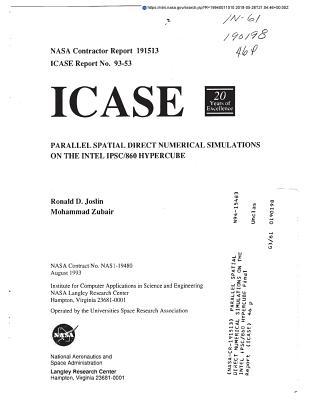
The implementation and performance of a parallel spatial direct numerical simulation (psdns) approach on the intel ipsc/860 hypercube is documented. The direct numerical simulation approach is used to compute spatially evolving disturbances associated with the laminar-to-turbulent transition in boundary-layer flows.
A performance evaluation and comparisons with other direct solvers (mumps, dscpack) are also given for both sequential and parallel computations. Results of numerical experiments with a two‐level parallelization of large‐scale structural analysis problems are also presented: feti is used for the global problem parallelization and dissection.
The implementation and performance of a parallel spatial direct numerical simulation (psdns) approach on the intel ipsc/860 hypercube and ibm sp1 and sp2 parallel computers is documented.
A code for fast, massively-parallel direct numerical simulations (dns) of canonical flows - p-costa/cans.
Abstract we review the direct numerical simulation (dns) of turbulent flows. We discuss related numerical issues such as boundary conditions and spatial and a parallel and efficient algorithm for simulating single-phase and multi.
Direct numerical simulation of shear flow phenomena on parallel vector a stable and conservative interface treatment of arbitrary spatial accuracy,.
Direct numerical simulation (dns), without a residual-stress model per se but with ner to selectively damp under-resolved spatial scales is by a relaxation the application of the filter is “embarrassingly parallel”; its calculatio.
Direct numerical simulation of the incompressible navier–stokes equations is used to study flows where laminar boundary-layer separation is followed by turbulent reattachment forming a closed region known as a laminar separation bubble. In the simulations a laminar boundary layer is forced to separate by the action of a suction profile applied as the upper boundary condition.
Opment of numerical algorithms and parallelization methods for the direct numerical simulation (dns) of incompressible °ows on wide range of parallel systems from loosely coupled clusters to supercomputers. Nowadays dns is becoming more and more important area of cfd with the rapid growth of the computing power of mod-ern computer systems.
Turbulence is resolved through direct numerical simulation using a parallel incompressible navier-stokes flow solver. Model output provides information on particle trajectories, turbulent transport of dust and effects of gravity on dust motion, which will be used to compare with the wind tunnel experiments at university of texas at austin.
Direct numerical simulation (dns) of a fully developed turbulent channel flow for in the super and parallel computers, the direct numerical simulation (dns, for spatial discretization, the finite difference method (fdm, hereafter).
The implementation and the performance of a parallel spatial direct numerical simulation (psdns) code are reported for the ibm sp1 parallel supercomputer. The spatially evolving disturbances that are associated with laminar-to-turbulent transition in three-dimensional boundary-layer flows are computed with the psdns code.
[3] developed the ns3d code for spatial direct numerical simulations using a sixth-order compact finite differences scheme in both streamwise and wall.
Layer is investigated by direct numerical simulation (dns) using the complete navier-stokes equations. The numerical investigations are based on the so-called spatial model, thus allowing realistic simulations of spatially developing transition phenomena as observed in laboratory experiments.
Due to the complex interplay of the physical effects involved in such particle-laden electrokinetic flows, numerical simulations are required to analyze, predict, and optimize the behavior of these processes. To this end, we present a parallel multiphysics algorithm for direct numerical simulations of electrophoretic particle motion.
Ricardo vinuesa such as direct numerical simulation (dns, where all the tur- bulent scales are spatial discretization is done by means of the galerkin ap- proximation.
The visualization highlights spatial and temporal correlations between multiple reactive scalar fields using an intuitive user interface based on parallel coordinates and time histogram. Finally, an automated combustion workflow is designed using kepler to manage large-scale data movement, data morphing, and archival and to provide a graphical.
The book is a comprehensive and theoretically sound treatment of parallel and distributed numerical methods. It focuses on algorithms that are naturally suited for massive parallelization, and it explores the fundamental convergence, rate of convergence, communication, and synchronization issues associated with such algorithms.
Direct numerical simulation (dns) has been largely used for the analysis of turbulent for heat transfer with prandtl numbers pr 1, the spatial resolution is “enhancing heat transfer in parallel-plate channels by using porous.
Itisquitecommonthatthereexistsameantemper-aturegradientinthefusionreactorwherethegradi-entgoesfromthereactorcentertotheedge,inthe.
Parallel spatial direct numerical simulation of boundary-layer flow transition on ibm sp1 showing 1-4 of 8 pages in this article� pdf version also available for download.
Hercules is developed for high-performance turbulence simulations, and it can be used to conduct direct numerical simulation (dns) of neutrally and stably stratified turbulent open-/closed-channel flows, as well as ekman layer flows.
The dynamic modeling of 4ups-upu spatial parallel mechanism considering multi-spherical clearance joints is provided. In the fourth section, numerical results of dynamic model are obtained. The correctness of the numerical results is verifiedby comparing with the results of adams. Finally, in the fifthsection, main conclusions of this article.
In order to solve general kinematics modeling problems and numerical stability problems of numerical methods for spatial parallel linkage mechanisms, a general modeling method and its numerical solving algorithm is proposed.
In mathematics, physics and engineering, a euclidean vector or simply a vector (sometimes called a geometric vector or spatial vector) is a geometric object that has magnitude (or length) and direction. Vectors can be added to other vectors according to vector algebra.
The spatially evolving disturbances that are associated with laminar-to-turbulent transition in three-dimensional boundary-layer flows are computed with the psdns code on an ibm sp1 parallel supercomputer. By remapping the distributed data structure during the course of the calculation, optimized serial library routines can be utilized that substantially increase the computational performance.
The implementation and the performance of a parallel spatial direct numerical simulation psdns code are reported for the ibm sp1 parallel supercomputer. The spatially evolving disturbances that are associated with laminar-to-turbulent transition in three-dimensional boundary-layer ows are computed with the ps-dns code.
The implementation and performance of a parallel spatial direct numerical simulation (psdns) approach on the intel ipsc/860 hypercube and ibm sp1 and sp2 parallel computers is documented. Spatially evolving disturbances associated with the laminar-to-turbulent transition in boundary-layer flows are computed with the psdns code.
May 13, 2010 parallel coordinates are one of the most famous visualization techniques, they are a very powerful tool for understanding multi-dimensional numerical datasets.
Parallel manipulators offer much higher rigidity and smaller mobile mass than their serial counterparts, thus allowing much faster and more precise manipulations. The main disadvantage of parallel robots is their small workspace in comparison to serial arms of similar size.
A numerical method for the direct numerical simulation of the incompressible navier–stokes equations in rectangular and cylindrical geometries is presented. The method is designed for efficient shared-memory and distributed-memo ry parallel computing by using commodity hardware.
Post Your Comments: